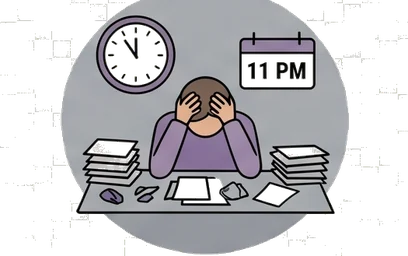
The shape of caregiver burnout
Burnout doesn't announce itself. It seeps in through 11 PM phone calls and a kitchen counter that hasn't been wiped in three weeks. What to watch for, and when to ask for help.
If you’re reading this at 11 PM, you’re not alone
78 percent of family caregivers report burnout feelings, often weekly. 87 percent report stress or anxiety. 40 to 70 percent meet the clinical bar for depression — far higher than non-caregivers. The numbers are not edge cases; they are the baseline experience of caring for an aging parent in America.
If you’re exhausted, irritable, sleeping badly, second-guessing every decision, and feeling guilty for resenting any of it, you are not failing. You are responding accurately to a documented psychological pattern. This piece is a map of that pattern — what it’s called, why it happens, and what actually helps versus what just sounds like it should.
What’s actually going on
Psychologists call sustained family caregiving a chronic stressor. Most stressors are events: a hard week at work, a fight with a partner, a deadline. The body’s stress response kicks in, the situation resolves, the body recovers. Caregiving isn’t an event. It’s a permanent low-grade activation — the cortisol stays up, the immune system stays suppressed, the sleep stays interrupted, the inbox of decisions never empties.
Several distinct patterns layer on top of that baseline:
- Caregiver burnout — emotional, physical, and mental exhaustion. Feels like fatigue that doesn’t respond to sleep, irritability that surprises you, a sense of being “on call” twenty-four hours that doesn’t turn off when you’re not actively doing anything.
- Compassion fatigue — the surprising one. Prolonged exposure to a loved one’s suffering can erode your capacity to feel for them. Caregivers describe it as numbness, distance, guilt for not feeling more. It is not a failure of love. It is the nervous system’s self-protection.
- Role confusion and identity grief — the shift from “daughter” to “nurse and decision-maker” doesn’t come with a ceremony, and the person you were before caregiving doesn’t get a farewell. Adult children especially describe a quiet grief for the life that paused.
- Anticipatory grief — mourning someone who is still alive, but changing. Common in dementia caregiving especially. Often the loneliest version because it’s harder to share — the person you’d normally grieve to is the person you’re losing.
The reason naming this matters: most caregivers experience these without vocabulary for them, and assume the symptoms are personal failures (“why am I so impatient with her?”) rather than predictable outcomes of the situation. The labels reduce the moral weight.
Why “just take care of yourself” doesn’t work
Every caregiving article tells you to practice self-care. Take a bath. Go for a walk. Meditate ten minutes. The advice is not wrong — it’s just incomplete.
Self-care addresses the symptoms (cortisol, sleep, isolation) without touching the cause (the sheer volume of cognitive load you’re carrying alone). A daughter who is the only person who knows her mother’s medication list, insurance details, doctor names, allergy history, and last lab values cannot solve that with a bubble bath. The cognitive load is what produces the burnout, and the cognitive load only goes down when other people can actually share it.
This is where psychology research has converged on a framework called Self-Determination Theory. Humans are most resilient to stress when three needs are met: autonomy (you have meaningful control over decisions), competence (you feel effective at what you’re doing), and relatedness (you’re connected to others and not alone in the work). Caregiving systematically attacks all three. You don’t control the disease. You often don’t feel competent because the situation is novel and the stakes are high. And you become structurally isolated because nobody else carries the same information.
The interventions that actually work address those three needs directly:
- Shared responsibility — structurally, not just emotionally. A sibling who says “let me know if I can help” has not reduced your load. A sibling who has the same calendar, the same medication list, and the same next-step list on their phone has. The shift from “managing the family” to “making the work visible to the family” is the relatedness lever.
- Reducing the always-on cognitive load. Anything that takes a piece of information out of your head and puts it somewhere durable + accessible to others lowers the baseline activation. Notes, medication lists, appointment trackers, visit summaries — the value isn’t the data, it’s that you stop being the only place the data lives.
- Professional help when burnout signs appear. Caregiver-focused therapy (CBT for guilt and anxiety, particularly) has strong evidence. So does respite care — even a single weekend off, structurally protected, resets the stress response in a way no app can.
- Validating the emotional reality. Naming what’s happening (“this is compassion fatigue, not lack of love”) doesn’t fix it but does reduce the secondary suffering — the guilt about the symptoms.
The positive side, honestly stated
Caregiving research also documents real gains. Many caregivers report deeper relationships with the parent they’re caring for, a kind of intimacy that wasn’t available before. A sense of having done something that mattered. Personal growth, perspective, gratitude that lands differently after sustained contact with mortality.
These are real, and they tend to land most clearly in retrospect — after the immediate stress resolves. While you’re inside it, the rewards can feel theoretical or even insulting. (“Yes, I’m developing empathy. I’m also losing my mind.”) Both can be true.
What this means for the people around a caregiver
If you’re a sibling, a friend, an extended family member who isn’t the primary caregiver and you’re reading this trying to understand: the most useful thing you can offer is not sympathy but specifics. “Let me know if I can help” is well-meaning and ineffective. “I can take Tuesday afternoon appointments for the next month” is help. “I’ll handle the insurance call so you don’t have to” is help. “I’m flying in next weekend so you can sleep for three nights” is help.
The cognitive load of figuring out what kind of help to ask for is itself part of the burden. Removing that step — by showing up with a specific offer — does more than sympathy ever does.
Where Kintaria fits, and where it doesn’t
Kintaria is software, not therapy. It can’t address depression, identity grief, or compassion fatigue directly. It can’t replace the conversation with a counselor or the weekend of actual rest.
What it can do is structurally reduce the cognitive load that drives the chronic stress. Notes that everyone sees. A medication list that updates for the whole family at once. Visit summaries that aren’t just in your head. A voice line you can call from the parking lot so the information doesn’t get lost between the doctor’s office and your kitchen. A bilingual mode so your parent isn’t outside her own care. Step-by-step playbooks for hospital discharge, after a fall, a new dementia diagnosis — so you’re not building the response from scratch each time.
That’s autonomy, competence, and relatedness via software. It is meaningful — and it is not enough by itself. If you’re recognizing yourself in the burnout description in this piece, the second-most-important thing you can do is set up a workspace and bring your siblings in. The most important is to talk to a professional. The Family Caregiver Alliance helpline (1-800-445-8106) and the Eldercare Locator (1-800-677-1116) are starting points. So is your own doctor — caregiver burnout is a legitimate reason for the visit, and they’ve seen it many times.
One more thing
The most common thing caregivers tell us after they set up a workspace and start using it isn’t “this saves me time.” It’s a version of “for the first time in a year, I don’t feel like I’m the only one who knows what’s going on.”
The caregiver who finally asks for help isn’t weak. She’s the only one in the family being honest about what’s actually required.