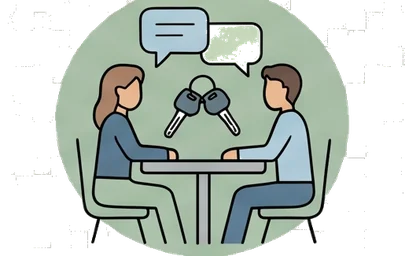
The car keys conversation
How families actually handle the moment when Dad shouldn't be driving anymore. The legal angle, the safety angle, and the conversation that, done right, leaves the relationship intact.
The shape of the problem, before the advice
If you’re reading this, you’ve probably already had one version of this conversation and it didn’t go well. The first thing to understand is that almost nothing about it is actually about driving.
What you’re asking her to give up isn’t a car. It’s the last reliable piece of evidence that she’s still in charge of her own life — how she gets to her hairdresser, her church, the grocery store on her own schedule. More than that, it’s the difference between being an adult who happens to be older and an old person who depends on her kids. Once she hands over the keys, the implicit contract that organized the relationship for sixty years — parent in charge, child supported — flips. She can feel that coming long before you start.
So if you walk in talking about the dent on the bumper or what the neurologist said about her reaction time, you’re not having the conversation she’s having. You’re talking about driving. She’s defending her standing as an adult. The two don’t meet, and they often end in tears, a slammed door, or the worst outcome — her smiling at you and then quietly continuing to drive.
Naming what the conversation actually is, before you have it, is what makes the rest work. You’re not trying to win an argument about safety. You’re trying to help your parent navigate one of the largest losses in the second half of her life in a way that keeps her alive and the relationship intact. Those are the two outcomes. Being right, getting it over with, having her thank you — not on the table.
This almost never works on the first conversation. Families that handle it well have three or four over several months, with information accumulating in between. A single sit-down that ends with your mother agreeing to stop driving is an ambush. Ambushes fail.
Signs it’s time, and signs it isn’t yet
Most families wait too long. The signs accumulate slowly, and there’s no obvious threshold where “concerning” becomes “decisive.” The accident that finally forces the conversation is usually preceded by a year of smaller things nobody added up.
The signs that actually matter — the ones geriatricians and OTs weigh — are more specific than “seems slower than she used to.” Watch for these, and write them down with dates:
- Getting lost on familiar routes. Not a wrong turn in a new neighborhood — pulling into the wrong driveway on her own street, missing the exit she’s taken every Sunday for twenty years, calling you because she can’t remember how to get home from the grocery store she’s shopped at for thirty. One of the most predictive signs.
- New dents and scratches with no story. A side mirror reattached with tape. A scratch she explains as “someone in the parking lot.” One is plausible. A pattern is the car telling you something she isn’t.
- Mail from the DMV, insurer, or local police. Tickets for rolling stops or failure to yield. A warning letter. A note from a neighbor. Signals from outside the family, which means they’re no longer something you can talk yourselves out of.
- What you see during visits. Riding shotgun for fifteen minutes tells you more than three months of phone calls. Drifting in the lane. Slow reactions at intersections. Confusion at a four-way stop. Trouble turning her head to check blind spots.
- The neurologist’s assessment. If she’s had a cognitive evaluation for memory, dementia, Parkinson’s, or post-stroke follow-up, the notes almost always include something about driving. Ask. The clinical picture usually arrives months before the family is ready to act on it.
- Medication changes. New benzodiazepines, opioids, sleep aids, certain antidepressants. Any of these can impair driving in ways she will not feel.
Useful distinction: any one of these is concerning. Two or three together, or any one combined with a formal cognitive diagnosis, is decisive. The trap is treating each sign as isolated instead of looking at the pattern. The dates are the difference between “we’re worried” and “here is what we’ve seen over four months.”
What isn’t yet decisive: driving slower, not driving at night, avoiding the highway, not loving left turns. Those are compensations, and an older driver who self-restricts is often safer than a middle-aged driver who doesn’t. It’s when the self-restrictions stop working that you have a problem.
The pathway that doesn’t make you the bad guy
The biggest unlock in most families is realizing you don’t have to be the one who takes the keys. There’s an entire infrastructure built around exactly this problem, and almost no family knows it exists until they’re three fights deep.
Most U.S. states allow physicians to report a patient whose medical condition may make driving unsafe. The mechanism varies — some require it, some allow it confidentially, some make it discretionary — but the result is the same: a concerned doctor can flag your parent to the DMV, which schedules a medical review, often including a road test or written re-examination. In a few states (California is the best-known), reporting is mandatory for conditions like dementia.
Practically: the conversation stops being “your daughter thinks you shouldn’t drive” and starts being “the state scheduled a re-examination because of the medical record.” Same outcome, different politics. The authority moves off the family. Your parent can be angry at the DMV. The DMV does not come to Thanksgiving.
To get there, ask the doctor directly. Most primary care physicians will dance around this — they don’t want the conflict either. Geriatricians and neurologists are more direct, because they see this every week. Phrasing that works: “We’re seeing X, Y, and Z at home. Can you assess fitness to drive and, if you have concerns, refer her for a formal road evaluation through the state?” Bring the dated observations. Doctors with a written record in front of them will act. If primary care won’t engage, ask for a referral to a geriatrician, neurologist, or driving-specialist OT.
The other route is the occupational therapy driving assessment — usually $300 to $500, clinical evaluation plus an on-road test in a dual-control vehicle, written report at the end. The advantage over the DMV path is speed: weeks instead of months. Many families use the OT assessment first and the DMV report as a second step. Either is almost always preferable to the family trying to extract the keys on its own authority.
If you have to have the conversation yourself
Sometimes the outside pathway isn’t fast enough, the doctor won’t engage, or your parent won’t go. Then you’re back to the kitchen table.
Start with a specific event, not the general worry. The general worry sounds like criticism of who she is; a specific event is a fact she can explain or sit with:
“Mom, I’ve been worried about your driving. We need to talk.” — She hears: I’m being judged. Defensive crouch. Argument.
“Mom, last Tuesday when I was riding with you to the cardiologist, you went past the turn-off twice and seemed confused at the four-way stop on Elm. Has that been happening more?” — A specific thing happened, she noticed, she’s asking. There’s an opening to respond honestly.
Then — the part most families skip — let her respond. Don’t fill the silence. Don’t come in with the prepared follow-up. She may admit something you didn’t know, or have been quietly worried herself, and the conversation you were dreading turns out to be one she’s been waiting for someone to start. More often than you’d guess.
Avoid “should” language. Each you should is heard as the daughter telling the mother what to do — the role reversal she’s fighting. Replace with observation and options. The doctor said the new medication makes most people drowsy. What about not driving on the days you’ve taken it?
Bring a backup plan. If the conversation is “give up driving,” the answer is no. If it’s “drive less, and here is what replaces it,” the math changes. Have alternatives loaded:
- A rideshare account in her name, on her phone, card on file — and sit with her and book one together so she’s done it once.
- A standing weekly schedule. Tuesday the grandkids for groceries. Thursday you for the doctor. Sunday church with the neighbor. Predictability beats volume.
- Paid driver options. Senior-focused services (GoGoGrandparent, ITNAmerica, local nonprofits, retired neighbors who drive for cash). $20 to $30 a trip is a fraction of what owning a car costs.
- Senior transit. Most counties have paratransit or a senior shuttle — often free, almost always underused. Call your local Area Agency on Aging.
- Delivery for groceries, prescriptions, meals. Removing driving as a need for routine errands shrinks the problem.
Pick the right setting. Not in the car. Not at a holiday meal. Quietly, at home, with one person — whichever adult child she trusts most on hard topics, not necessarily the primary caregiver. If there’s someone she respects who isn’t a son or daughter — a niece who’s a nurse, a brother, a longtime friend — they often have more standing here than the children do.
What to do if she refuses
If the conversation goes badly, or she agrees and quietly keeps driving, you have an escalation ladder. Each step adds outside authority and reduces the daughter-versus-mother framing.
1. The self-assessment. AAA’s RoadWise Review is a free online tool covering the cognitive and physical functions that affect driving. Not diagnostic, but seeing her own results sometimes cracks the resistance in a way family observation can’t. AARP has a similar smart-driver course. Nothing about either feels like an attack.
2. The occupational therapy driving evaluation. $300 to $500, written report, real on-road test. Frame it as “let’s get an objective opinion so we can stop arguing.” Parents who refuse a family conversation will often agree to a professional one, because the professional isn’t their daughter.
3. The physician-reported DMV pathway. Slower, but carries legal authority. If she fails the re-examination, her license is suspended or restricted, and the responsibility rests with the state.
4. The insurance lever. If her insurer raises premiums after an at-fault accident or non-renews, the cost becomes its own argument. Don’t fight it on her behalf. Let the price signal land.
5. Removing or disabling the car. Last step, and it carries real costs. Selling the car, hiding the keys, disconnecting the battery — these stop the driving. They also damage the relationship and confirm her worst fear: her children no longer trust her with her own life. For a parent with intact judgment, this is a last resort.
The exception is dementia. Once cognitive impairment progresses past a certain point — moderate-stage Alzheimer’s, Lewy body, severe vascular dementia — a person who can’t remember whether she drove today or whether her license was revoked will get back in the car regardless of yesterday’s decisions. At that stage removing the vehicle is the only thing that reliably works, and the damage to trust is largely irrelevant because the memory won’t persist either. Until you’re clearly past that threshold, don’t use this option.
What this won’t fix
It won’t make her glad you had the conversation. There is essentially no version where she thanks you, hugs you, and says you were right. The best realistic outcomes are quiet acceptance, a few weeks of cold silence, or an argument followed by gradual resignation. Plan for one of those.
It won’t prevent the grief that follows. Loss of driving is correlated with declines in mood and social engagement, and older adults who stop report depression at higher rates than those who continue. Take the alternative-transportation piece seriously — the goal isn’t to take a car away, it’s to keep her socially connected after.
It won’t fix the underlying disease. If driving has become unsafe because of dementia, Parkinson’s, or stroke recovery, the keys are one early step in a longer arc of loss. The conversations about the stove, living alone, money, and bigger care decisions are coming. The skills you build here — observe, document, route through outside authority, bring options — are the same ones you’ll need next.
It won’t make the siblings agree on timing. One will think it’s overdue, one premature, one will be conveniently unavailable. You’ll have to do it anyway. Shared observation in writing is the best tool for getting siblings roughly aligned — don’t wait for unanimity.
Where Kintaria fits, and where it doesn’t
What Kintaria does well in this conversation is take it out of any one person’s head. The dated observations — the time she missed the turn-off, the dent that appeared in March, what the neurologist said in April — live in one place, visible to every sibling. When you walk into the geriatrician’s office, you’re not relying on memory. When the family conversation happens, it isn’t “one daughter’s opinion” — it’s a shared record three siblings have been adding to for six months.
That changes the politics more than people expect. The sibling who thinks you’re overreacting can see, in writing, that this isn’t a sudden alarm. The parent who feels ganged-up-on can see the concern is grounded in specific events. The doctor gets specifics to act on. Nobody is the bottleneck.
What we can’t do is have the conversation for you, drive your parent to the appointment, or fix the grief that follows. We can’t make an avoidant sibling engage. Those are conversations for your family, and sometimes a counselor.
Two free hotlines worth keeping in your phone. The Family Caregiver Alliance (1-800-445-8106) connects you with support groups and family counselors who specialize in this conversation. The Eldercare Locator (1-800-677-1116) is the federal information line for local services — Area Agencies on Aging, senior transportation, geriatric care managers. Both are real, both are free. Use them.
One more thing
The framing that helps most caregivers get through this is to be honest about what you’re optimizing for. Not your mother being pleased with you. Not a clean resolution. Not being remembered as the good daughter. Two outcomes, and only two: she is still alive a year from now, and the relationship survives.
Those are not the same as her thanking you, or her never being angry. They are, however, achievable — and they are the actual definition of having done this well. A year from now, if she is alive and you are still talking, you handled this conversation correctly. Whatever it cost emotionally is the cost of having done the right thing.
You are not trying to win the conversation about the car keys. You are trying to keep your mother alive, and stay her daughter while you do it. Those are the only outcomes that matter.