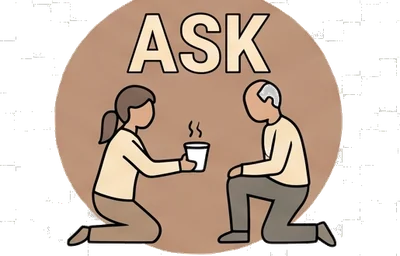
When a parent refuses help
The book on how to ask. Not the chess match. The slow, repeated, gentle returning to the topic that actually works on the third or fourth try.
The shape of the problem, before the advice
You spent two weeks lining up the home aide. Interviews, references, schedule, money. The aide arrived Tuesday at nine. Your mother sent her home at nine-twenty and called to say she didn’t need a babysitter, thank you, please don’t do that again.
If you’re reading this, some version of that scene has already happened — with the aide, the medication, the doctor, the car keys, the second-floor apartment. You did the work. She said no. You are now exhausted in a way the caregiving literature doesn’t have a name for: the exhaustion of effort that gets rejected.
Here is the thing almost no one says directly. The refusal is almost never about the specific thing being refused. It is about something underneath — almost always identity, autonomy, and the load-bearing fact that she is still in charge of her own life. The medication, the aide, the move are proxies. The harder you push on the proxy, the more entrenched the refusal becomes, because every push confirms the fear she’s defending against: that she’s losing control of who she is.
You weren’t arguing about the aide. You were arguing about whether she still gets to decide things. She’ll choose dignity over safety nearly every time, because for most adults, dignity is what makes safety worth having. The lever you’ve been pulling is the wrong one.
What kind of refusal is it?
Before you do anything, name what’s being refused. Four common categories look similar from the outside and need different approaches.
- Refusing a specific intervention — the medication, the fall alarm, the cane, the hearing aids. Usually about loss of independence. Every device is a small admission her body isn’t what it was. The intervention is declined; the trajectory is what’s resisted.
- Refusing a person — the aide, the visiting nurse, a particular sibling, a daughter-in-law. Usually about privacy, pride, or old family history. She doesn’t want a stranger in her bathroom, or her son to see her struggle, or the daughter-in-law she never warmed to running her kitchen.
- Refusing a setting change — moving in with a child, assisted living, leaving the house she has lived in for forty-six years. Usually about losing home, community, and the physical reminders of the life she built. Not a logistical question; a question about whether that life is over.
- Refusing to acknowledge a diagnosis — dementia especially, but also serious cancer, a failing heart, vision loss affecting her driving. Usually about fear of the future. Accepting the diagnosis means accepting what comes next, and what comes next is mostly things she doesn’t want.
You can spend months pushing on the wrong category. An aide refusal that is actually a privacy refusal will not move with better aides. Figure out the category first.
What doesn’t work
Almost everything most families try first.
- Logic. “But the doctor said.” She isn’t refusing because she missed an argument. Repeating it louder doesn’t address the thing underneath, and it tells her you think she didn’t understand the first time — which is its own insult.
- Frequency. The instinct, when told no, is to ask again next week. What happens is the opposite: every repetition cements her position, because saying no out loud makes it more identity-defining each time. By the fifth ask, she is no longer just declining the aide. She is the woman who decided not to have one.
- Ganging up. A coordinated sibling talk feels organized to you. To her it feels like an ambush. It triggers every defensive reflex available and almost always ends with her more entrenched. Family meetings work for sibling coordination; they rarely work as confrontations with the parent.
- Confrontation in front of grandchildren. Or neighbors, or anyone whose opinion she cares about. You’re adding humiliation to a situation that is already, for her, about her dignity. She will refuse harder to defend her standing.
- Threats and ultimatums. “If you don’t accept the aide, I can’t keep doing this.” Sometimes true, sometimes the only honest thing left. Almost never useful as a tactic — she’ll hear it as a bluff or a betrayal, and you’re left having to follow through on a threat that may not serve anyone.
If you’ve been doing these, that isn’t failure. They’re the obvious moves. They just don’t work.
What sometimes works
Nothing always works. These are the moves that shift refusals more often than not.
Ask what she’s afraid of, instead of pushing the solution. “What about taking the medication has been hard?” “What worries you about someone being in the house?” The fear underneath is almost always more specific than you assumed, and more solvable than the surface refusal. A woman refusing an aide because the last one stole from her sister is a different problem from one refusing because she doesn’t want anyone to see the kitchen.
Offer her control of the smaller version. “Would you try it for a week, then we decide together?” “Would you let the cleaner come twice this month?” The trial frame preserves her veto — the currency actually in dispute. Many things she’ll refuse forever in principle, she’ll try for a week.
Use outside authority instead of you. Advice that lands as nagging from her daughter often lands as reasonable from her doctor, her pastor, her older sister, or a peer who already made the same decision. Advice from family activates the parent-child dynamic; a peer or outsider doesn’t carry that charge.
Reframe her as the one in charge. “We need your help figuring out how to keep you here.” “What do you think we should do about the stairs?” She is, legally and morally, in charge of decisions about her own life. Phrasing the question that way is often the difference between a refusal and a conversation.
Time. Some refusals soften on the third or fourth conversation, especially after a small scare — a near-fall, a brief hospitalization, a friend her age who moved into assisted living and is doing fine. Don’t push in the moment. Bring it up two weeks later, in a different context.
The specific hard ones
The most common refusals, with what tends to work on each.
Refusing medication. Start with the question — “what about taking it has been hard?” The issue is often something specific: an unnamed side effect, a swallowing difficulty, a bad experience decades ago she has generalized, a cost concern. Many drugs have dosing flexibility or substitutes; the prescriber would rather adjust than have her refuse. The pharmacist is often a better messenger — a neutral expert, not family.
Refusing to see the doctor. Don’t book it as “an evaluation.” Book it as a Medicare Annual Wellness Visit — free, routine, encouraged every year, and a legitimate non-threatening reason to be in the office. Once she’s there, the doctor can do the actual assessment that prompted the visit. “Routine” doesn’t require her to admit anything is wrong.
Refusing an aide. Do not use the word caregiver to her face. The label is often what’s being refused, not the service. Start small, time-limited, task-bounded — “a cleaning person twice a month,” “someone for the heavy laundry.” Frame it as help with the task, not help with her. Once a specific person has been in the house a few times without incident, the relationship expands. Many families end up with a real caregiving arrangement that started as the housekeeper hired for two hours a week.
Refusing to move from a dangerous home. The hardest one. Often only a crisis — the fall you were trying to prevent — breaks the impasse. Until then, the work is mitigation, not persuasion. Grab bars. Rugs removed. A stair lift if the geometry allows. Better lighting. An emergency button she’ll actually wear. An in-home aide on the days you can manage it. Document the concerns and conversations in writing — if a crisis comes, your past self will have left a record to decide from. You can do everything right and the move still won’t happen until something forces it. That isn’t your failure.
Refusing to acknowledge dementia. Don’t force the diagnosis conversation. Making her say the word won’t change what’s happening in her brain, and it will cost trust you’ll need later. Work with the behaviors. “Let’s make sure your important papers are organized” doesn’t require her to admit she’s losing memory; it just gets the papers organized. “I want to learn the bills in case I need to step in” doesn’t require her to admit she can’t; it just teaches you the system.
Capacity and the line
At some point in some refusals, the question changes from a relational one to a clinical and legal one. Some families invoke that line too early; some wait too long.
Adults with capacity have the legal right to refuse care, even unwise refusal, even refusal that will probably hurt them. This is morally hard and legally settled — the alternative, in which others can override an adult’s decisions about her own body, is worse than the cases where someone makes a bad call.
Capacity is a clinical determination, not a family one. If you genuinely believe she’s no longer deciding with capacity — not “she’s being stubborn,” but “she doesn’t understand the consequences” — that requires a doctor’s assessment, ideally a geriatrician or neuropsychologist. Capacity is decision-specific: she may have capacity to refuse a medication while no longer having capacity to manage finances. Don’t collapse it into “she’s incompetent.”
For situations beyond capacity — clear self-neglect, hoarding that creates a fire hazard, an unsafe home she won’t leave — Adult Protective Services (APS) exists. Calling APS is a serious step most families resist, sometimes too long. APS workers in most states aren’t trying to remove people from their homes; they’re trying to assess and connect to services. The Eldercare Locator (1-800-677-1116) can route you to the APS office in your area and tell you what they actually do before you make the call.
What this costs you
The refusal-shaped form of caregiving is the most demoralizing one. You’re doing real work and watching it get rejected by the person you’re doing it for. It activates every old wound about not being heard.
Resentment is normal. Not occasional resentment; the steady, low-grade kind that shows up in your tone before you notice it. You can love your mother and resent her at the same time. It doesn’t mean you’re a bad daughter. It means you’re doing one of the hardest things people do, without the cooperation of the person whose cooperation matters most.
Sharing the load helps, and not for the reason you’d think. It doesn’t change her refusal — she will refuse your brother’s suggestion the same way she refused yours. But when the burden is yours alone, every refusal is also a referendum on your judgment, your worth, your relationship with her. When the burden is shared, the refusal is just a refusal. The part of your nervous system that’s been treating each no as a personal verdict can finally stand down.
You also don’t have to keep offering the same thing forever. Part of the work, quietly, is deciding which battles to keep fighting and which to put down. Some you’ll reopen every month. Some you’ll accept and shift to mitigation. Some you’ll simply stop bringing up. That isn’t giving up. It’s choosing where your finite energy goes.
Where Kintaria fits, and where it doesn’t
Kintaria is software, and software cannot make your mother accept the aide. What it can do is make the refusal a shared problem instead of your private one. When the pattern is visible to your siblings — the medication declined three times, the visit pushed off twice, the aide who lasted twenty minutes — the conversation stops being you trying to convince them it’s as bad as it is. The notes, the visit summaries, the pattern are right there.
Shared visibility also lowers the temperature on the next attempt. A sibling who can see what the cardiologist said can add a second voice without you having to brief her. The voice line captures what the doctor recommended while it’s fresh. The bilingual mode lets your mother engage with her own care record in the language she trusts — which sometimes, quietly, moves the refusal more than argument did.
What we can’t do is have the conversation for you. Those belong to you, your family, her doctor, and sometimes a counselor or care manager. The Family Caregiver Alliance (1-800-445-8106) runs a free helpline staffed by people who’ve heard this exact problem hundreds of times. The Eldercare Locator (1-800-677-1116) connects you to your local Area Agency on Aging, which can send a geriatric assessment to the house — sometimes the outside expert she’ll listen to when she won’t listen to you. Both are free.
One more thing
The hardest part of a parent refusing help isn’t the refusal. It’s what the refusal does to the part of you that still wants to be a good daughter or son — the part that hears “no” and translates it, against your will, into you’re not helping, you’re not enough. That translation is the lie. The help being declined is information about her, not a verdict on you.
The refusal may not break. Some don’t. You may eventually have to make peace with the version of this where she stays in the second-floor apartment until something forces a change, and you did everything you could, and that has to be enough. That isn’t a happy ending. It is, sometimes, the only honest one.
The parent who refuses help is not refusing you. She is refusing the version of the future where she no longer gets to decide. Understanding that doesn’t change the refusal — but it changes who you have to be while you’re hearing it.