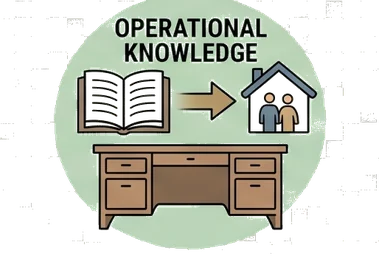
The workspace that outlives you
For parents of adult children with disabilities or lifelong complex needs: the operational knowledge that lives in your head, why it has to be externalized while you can still do it, and what goes in the workspace a sibling will someday inherit.
The question parents don't say out loud
Every parent of an adult child with a developmental disability or complex medical needs eventually arrives at the same question, and almost never asks it directly.
The question is: who will care for our child when we no longer can?
It sits underneath every other decision. The choice of group home or supported living. The decision about whether to set up a special-needs trust now or later. The conversation with the other adult children about whether one of them will eventually step in. The exhausted refusal to think about it for one more week, because thinking about it is the worst part of an already-hard life.
Most parents in this situation are simultaneously holding two things: the daily, hour-by-hour competence required to manage a complex caregiving life, and the unbearable awareness that one day they will no longer be able to provide it. The first they are very good at. The second has no good answer, only better and worse preparation.
This article is about the workspace as a piece of that preparation. Not as a solution — there isn't one — but as a thing you can hand over, with everything in it, on the day someone else needs to pick up where you left off.
What gets lost in a transfer
The hardest thing to transfer in lifelong caregiving is not the legal authority. That's a paperwork problem with a paperwork answer: a special-needs trust, a successor trustee, a transition of guardianship if applicable. Those things can be set up by an estate attorney, and most parents in this situation have done at least some of them.
The hard thing to transfer is the operational knowledge. The thirty years of context about which medications work and which were tried and abandoned and why. The understanding of which behaviors signal pain and which signal preference. The relationships with the specific specialists and the day program coordinator and the dentist who finally takes Medicaid patients and is gentle. The thousand small accommodations that make daily life livable, none of which are written down, all of which were learned by watching closely for years.
When this knowledge sits only in a parent's head, the transition to a sibling or another caregiver is dramatic and traumatic. The new caregiver has to rebuild from scratch, and the things that are obvious to anyone who has been there for thirty years are invisible to someone who is starting from the medical chart.
The reasonable goal, while you can still do it, is to externalize that knowledge — to move it from your head into a place that survives you. Not all of it. You will never write down everything you know. But the parts that matter most: the medical timeline, the medication history with its rationale, the legal documents, the people in the support circle, the operational facts of daily life. Enough that a sibling could pick up the workspace and not be starting from zero.
The structural advantages of doing it now
The first reason to do this now rather than later is that you are the only person who can. Nobody else has the context. If you wait, the context evaporates.
The second is that the process of building the externalized version often reveals gaps in the formal one. As you write down the rationale for each medication, you may notice that one of them has been on the list for fifteen years and you can't remember why, and a call to the doctor confirms that it could probably come off. As you document the support circle, you may realize that two of the key people are also aging and don't have backups. As you photograph and file the guardianship paperwork, you may notice that the language is from the original petition and hasn't been updated to reflect the program changes since. None of this is exciting. All of it is the kind of cleanup that's easier to do once, slowly, than to discover under pressure later.
The third reason is that the externalization itself creates the possibility of help. When the operational knowledge lives only in your head, no one can spell you. You cannot take a weekend off because you are the only one who knows what to do when the day program closes for a holiday. When that same information is in a shared workspace, a sibling or hired aide can step in for a long weekend without a forty-five-minute briefing call beforehand. The workspace converts you-only knowledge into shareable knowledge, and that has compounding effects on your own capacity to rest.
What goes in it
Without getting prescriptive, the categories that matter most for an adult-child workspace tend to be:
Medical history, deep. Decades of labs, hospitalizations, procedures, medication changes — and the rationale for each, where you have it. The medication review tool is especially useful here, because polypharmacy in this population is common and reviewing the list against current best practice often finds something worth adjusting.
The legal kit. Guardianship orders if any, special-needs trust documents, ABLE account paperwork, advance directives, the will (yours and the trust's), HIPAA authorizations for relevant providers, IEPs and transition plans even if they're old (they're still part of the narrative). All scanned, all OCR-searchable, all in one place.
The support map. Names, phone numbers, and roles of every person in the support circle. PCP, specialists, dentist, ophthalmologist, day program coordinator, residential support, behavioral therapist, neighbors who help, transportation arrangements, the lawyer who drafted the trust, the financial planner. This is the call list a successor caregiver will need on day one.
Operational facts. The things only you know. The morning routine. The way to give the eye drops without a struggle. The names of the foods that work and the ones that don't. The signs of a UTI in someone who can't always describe what's wrong. The phrases that calm and the phrases that escalate. These are awkward to write down because they feel obvious to you. Write them anyway.
The succession plan. Who will be the next primary caregiver, what role do they play now, what role will they play later, and what's the trigger for the transition. A document, even a rough one, that says "if I am hospitalized for more than three days, here's what happens" is enormously valuable. Most families don't have one.
Inviting the next caregiver in early
The sibling who will eventually take over is usually one of two profiles: an adult child of yours who has stayed in close orbit, or a younger sibling of the person being cared for who has always been involved in some way.
Either way, the best move is to bring them into the workspace as a caregiver — not as an observer — well before any transition is contemplated. Their access starts as light: they read the activity feed, they see the medications, they know who the specialists are. Over time, as they get more comfortable with the operational details, they pick up small pieces. Refilling a prescription. Going to a routine appointment. Reading an EOB and filing it correctly.
This is the part that most parents skip, often because the parent has been doing all of this for so long that it's faster to keep doing it than to teach someone else. The transfer of operational knowledge, like the building of it, is a long slow process. The earlier it starts, the less traumatic the eventual handoff.
If there is no obvious successor — sometimes there isn't — the workspace is still valuable, because it makes it possible for a professional case manager or a guardianship trustee to step in with the context they would otherwise lack. The work of preparing it is the same.
The conversation with the other adult children
Most parents of an adult child with a disability also have other adult children. The conversation with them about what happens later is one of the hardest in family life.
There's no script for it that we can write here. But there are a few things that make the conversation a little easier to have, and they all involve having something concrete to point at rather than asking the other adult children to imagine.
A workspace that exists, with the medical history, the legal documents, the support circle, the routine — is something concrete. A conversation that starts "here's how it actually works today, can we walk through it together" lands better than a conversation that starts "I need to talk to you about the future." The second sentence makes everyone tense. The first sentence is an invitation.
The workspace also takes some of the emotional charge off the question of "who will do this." When the other adult children can see, in detail, what's involved, they can have a more grounded conversation about what they could realistically take on. Sometimes the answer is "I can be the financial trustee, but I can't move them in with my family." Sometimes it's "I'd want to do this if I had this much support." These are useful answers, and they're more likely to come out when the alternative isn't a blank sheet of paper.
The work that doesn't have a payoff for you
Most of the work we've described in this article will not benefit you directly. You already know everything that goes into the workspace; you don't need it. You're doing it for whoever comes after.
That's a hard form of work to motivate. There's no obvious return on Sunday afternoon spent scanning twenty-year-old IEPs. Nobody is going to send you a thank-you note for documenting the medication rationale. The reward is purely the reduction in suffering for someone you may not be around to meet.
What we'd say is that most of the parents we've talked to who have done this work describe it as the single most useful thing they did in the later years of caregiving. Not because of any particular individual moment of payoff, but because the underlying weight they were carrying — the weight of being the only one who knew — got lighter by tiny increments every time they wrote something down.
It's not the only kind of preparation. It's not a substitute for the legal work, the financial work, the conversations with siblings, the search for the right residential placement, any of that. It's just one piece. But it's a piece that, in our experience, almost nobody else is helping you with, and it tends to be where the operational gap is most painful when it finally shows up.
Do it slowly. Don't try to do it all in a weekend. A single piece each Sunday for a year would put you ahead of almost every family in the same situation. The workspace will be ready before you need it to be, which is the only acceptable timeline.