Caring for a loved one with substance use disorder
Caring for a family member with substance use disorder
Substance use disorder reshapes a family in ways most caregiver frameworks don't cover. The patient is often resistant to treatment, the medical system isn't built to coordinate with families, and the cost — financial, emotional, and across generations — is unusually high. Here's the orientation, with the harm-reduction reality the field has settled on.
What changes for the family
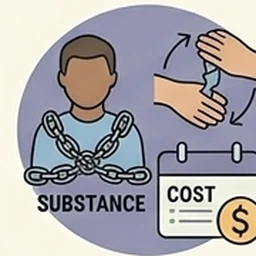
Substance use disorder (SUD) — alcohol use disorder, opioid use disorder, stimulant use disorder, and others — is a chronic, relapsing medical condition with disproportionately high family caregiving burden. The family's role is shaped by several patterns that don't fit other chronic diseases. The patient's relationship to treatment is often ambivalent or actively resistant; the "they have to want it" framing is partially true but oversimplified (motivation is itself something treatment helps build). The medical system's coordination with families is weak — addiction medicine is poorly integrated with primary care, mental-health, and emergency medicine in most regions. The harm-reduction reality the field has consolidated around — naloxone in every home with an opioid user, never use alone, fentanyl test strips, medication-for-addiction treatment (MAT) for opioid use disorder — sometimes conflicts with the abstinence-only models families were raised with. The overlap with serious mental illness, with trauma, with chronic pain, and with other chronic diseases is substantial; treatment that addresses only the substance use without the underlying drivers often fails. And the financial + legal + custody consequences often layer on top of the medical reality in ways most families weren't prepared for.
What to set up early
The window after diagnosis is when families have the most leverage to set the structure that the rest of the journey will lean on. The longer you wait, the harder some of these get.
- Naloxone (Narcan) in every home where opioid use is present. Available over-the-counter as a 4mg nasal spray; most insurance covers it; community-distribution programs give it away free. The overdose-reversal medication that saves lives — including in situations where the family didn't know opioids were being used.
- Connection to SAMHSA's 24/7 helpline (1-800-662-4357). Free, confidential, in English + Spanish, doesn't require insurance. Treatment locator, family-resource referrals, crisis support.
- Education about medication-for-addiction treatment (MAT). For opioid use disorder, buprenorphine (Suboxone) and methadone are evidence-based, life-extending treatments that reduce overdose deaths by 50%+. Family understanding + support for MAT — vs. the still-common "you're just trading one drug for another" framing — measurably improves outcomes.
- A Family-to-Family-style program — Al-Anon (for families of people with alcohol use disorder), Nar-Anon (for opioid + other drugs), SMART Recovery Family & Friends. Peer support specifically for family members of someone with SUD. The relief of meeting others who understand the dynamic is structurally important.
- Legal documents while the patient is well enough to sign — durable POA for healthcare and financial decisions, advance directive, sometimes a substance-use-specific advance directive that documents the patient's preferences for future treatment.
- A safety plan that includes financial separation if needed. Joint accounts, shared credit cards, joint mortgages — these can become vectors for financial harm during active use. Separating doesn't mean abandoning; it means protecting the family's ability to keep helping over the long term.
The hardest moments
The moments families describe as the most difficult are often the ones nobody warned them about. Knowing what's likely coming doesn't make any of these easy — but having language for them, and a workspace to bring the family back together when they happen, helps.
- An overdose. For opioid use disorder specifically, overdose is often the moment that reshapes the family's relationship with the patient and with the disease. Survival depends on naloxone availability + someone present. Post-overdose is one of the highest-risk periods for re-overdose; treatment access in the first 72 hours matters.
- A relapse after a period of recovery. The shame, the grief, the practical scramble — all real. The medical fact: relapse is part of the chronic-disease pattern of SUD; the question is how the family + the treatment team respond to it. Most evidence supports rapid re-engagement with treatment, not punishment.
- The decision about boundaries vs. continued engagement. "Letting them hit bottom" is an idea that's done real damage; modern addiction medicine doesn't support it. But there are limits to what a family can absorb. Where to draw boundaries is genuinely hard; therapists experienced in family-of-SUD work help.
- When SUD interacts with parenting — custody decisions, child-protective-services involvement, the impact on grandchildren. The intergenerational pattern is real, and breaking it is real work. Family therapy specifically helps; isolated individual treatment for the person with SUD often misses this dimension entirely.
Playbooks that map to this
Kintaria's playbooks are step-by-step for the specific moments that show up in this caregiving arc. Each one opens in your workspace and personalizes from your answers.
- Wellness · OngoingWhen you're burning out.
- Spouse · OngoingWhen you are the caregiver-spouse.
- Foundation · One-time setupGet the legal paperwork in order.
- Parent · Financial interventionWhen your parent's bills become a problem.
- Sibling · Inheriting the careYour parent was caring for your sibling — and now they can't.
National organizations + helplines
These are the organizations the field considers the standard starting points. All free, all real human helplines (the AI-on-the- phone caregiver line is a different category — this is people trained in the specific condition).
- 1-800-662-4357 · 24/7 · English + Spanish
The federal substance-use + mental-health helpline. Free, confidential, no insurance required. Treatment locator (FindTreatment.gov), referrals to family-support programs. The single best first call.
- Meeting Information · 1-888-425-2666
For families + friends of people with alcohol use disorder. Peer-support meetings in person + online, the Family Group Conference Approved literature, sponsor program. The longest-established and most-attended SUD family-support organization.
- 1-800-477-6291
For families + friends of people with substance use issues (opioids, stimulants, marijuana, others). Same model as Al-Anon — peer-support meetings, literature, sponsor program. Local groups across the country and online.
A secular, evidence-based alternative to Al-Anon / Nar-Anon. Uses CRAFT (Community Reinforcement and Family Training) — the most-studied family-side SUD intervention. Online and in-person meetings.
- Parent Helpline · 1-855-378-4373
Family-focused organization specifically. Parent helpline (real people, 24-hour callback), one-to-one coaching with trained parent coaches, peer-support community, harm-reduction resources.
Recovery-community advocacy. Local recovery-community organizations across the country offer peer recovery support that complements clinical treatment; the family connection points are deep.
NIH National Institute on Drug Abuse + National Institute on Alcohol Abuse and Alcoholism family-side resources. Authoritative, plain-language, free.
How a Kintaria workspace helps
Kintaria is a calm, shared family workspace built for the work this diagnosis is about to create. The medication list lives in one place (so the third sibling who flies in for the weekend doesn't have to re-learn what changed). The appointment calendar is shared (so the family doesn't double-book or miss the rheumatology follow-up). The activity feed is honest about who did what (so the primary caregiver isn't silently carrying everything). And the workspace is bilingual — patient reads in their preferred language, family reads in English — which matters more than people expect when the diagnosis itself is already disorienting.
Free 1-year trial for the first 500 founding families. No credit card.
A note on what Kintaria is (and is not)
Kintaria is not a clinical tool, not a medical-decision substitute, not a replacement for the substance use disorder care team. The orientation on this page is for families coordinating care; specific clinical decisions need the patient's clinician. The escalation cues throughout the workspace are honest about that boundary.
See also: all conditions · all playbooks · national resources directory